Excavation Cost Guide · Toronto & GTA
10 Factors That Affect the Cost of an Excavation Project in Toronto
Every excavation project is priced differently. Here is exactly what drives the number — and what to watch for before you sign a contract.
Licensed & Insured · 10+ Years of Experience
Excavation is one of the most variable line items on any construction budget. Two projects in the same neighbourhood — similar footprints, similar depths — can come back with quotes that differ by 40% or more. The reason is never one thing. It is a combination of site-specific factors that a contractor either accounts for upfront or discovers mid-project.
This guide breaks down the ten factors that most directly affect excavation cost in Toronto and the GTA — based on real project conditions, not generic industry averages. If you are a builder, developer, or general contractor evaluating a quote, this is the framework that separates a solid estimate from a number that will grow.
Quick Answer
In Toronto and the GTA, excavation projects typically run $30–$120 per cubic yard for standard soil, and $80–$200+ per cubic yard for rock or highly restricted urban access sites — before disposal, mobilization, shoring, and permitting. The total cost of a residential foundation excavation in Toronto commonly ranges from $15,000 to $60,000+, depending on scope, soil, depth, and site conditions. Confirm exact pricing with a site review and written quote.
Wallace Services Referenced in This Article
What Drives Excavation Cost in the GTA
These are not abstract variables. Each one has a measurable impact on hours, equipment, and crew requirements. Understanding them helps you evaluate quotes critically — and avoid the projects that look cheap until they are not.
The type of work being done is the single biggest cost driver. Foundation excavation for a new build is a fundamentally different operation than utility trenching or pool excavation — even if the cubic yardage looks similar on paper. Equipment selection, crew size, timeline, and permit requirements all flow from the project type.
Common projects requiring excavation across the GTA:
- Foundation excavation — new residential or commercial construction
- Basement lowering and underpinning — adds depth to existing structures
- Site preparation and grading — large-scale development clearing
- Pool excavation — residential and commercial
- French drain and stormwater drainage — perimeter and lot drainage
- Utility corridor trenching — pipe and conduit installation
- Pre-demolition clearing — removing existing foundations or slabs
- Soil remediation — contaminated land clearance
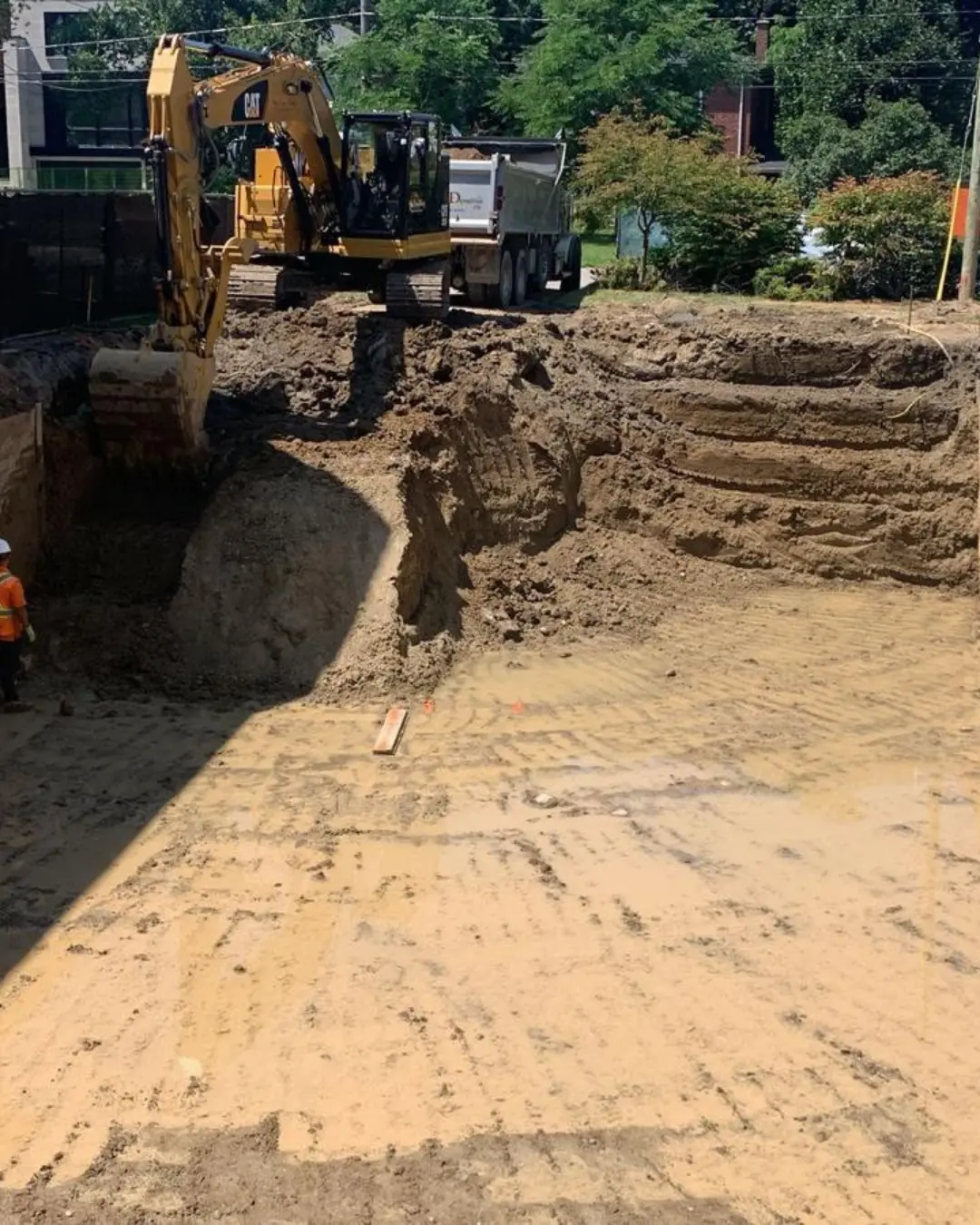
This is where projects in Toronto consistently surprise clients who used general pricing to budget. The GTA is not uniform ground. Soil conditions vary significantly across the city and surrounding municipalities, and each type affects cost directly.
- Heavy Toronto clay — dense, cohesive, and slow to excavate. Common in the east end and along the Scarborough bluffs. Increases hours and equipment wear.
- Sandy or mixed fill — unstable under load, may require additional retention even at moderate depths. Found in parts of North York and older developed areas.
- Shallow bedrock — close to surface in central Toronto and the Niagara Escarpment corridor. Requires specialized breaking equipment and significantly increases cost per cubic yard.
- High water table — common in lower-lying areas. Requires dewatering pumps and equipment, adding both time and cost to the operation.
A contractor who has not reviewed your site’s soil conditions before quoting is not quoting your project — they are guessing at it.
Greater depth and volume multiply every cost category: equipment hours, labour, soil removal, and disposal. But depth is not a linear cost driver — there are threshold points where the job fundamentally changes.
Below approximately 1.2 metres (4 feet), slope protection requirements activate under Ontario’s Occupational Health and Safety Act. Below approximately 2.4 metres (8 feet), engineered shoring is typically required in urban Toronto conditions. Each threshold adds a new cost layer.
| Material Type | Approx. Excavation Rate (GTA, 2026) | Disposal Cost |
|---|---|---|
| Standard soil / clay | $30–$80 per cubic yard | $25–$55 per cubic yard |
| Sandy fill / mixed | $25–$60 per cubic yard | $20–$45 per cubic yard |
| Rock / bedrock breaking | $80–$200 per cubic yard | $45–$90 per cubic yard |
| Ranges are starting points. Actual pricing depends on site access, volume, and full scope. Confirm with a written quote after site review. | ||
Excavation in Toronto is not the same as a rural dig. Access is restricted. Lots are narrow. Neighbours are close. Residential permit parking rules limit equipment staging. GTA traffic extends mobilization and haulage times in ways that simply do not apply outside the city.
A piece of equipment that travels easily on a rural highway may require multiple loads, police escorts, or route-specific permits to reach a midtown Toronto site. Getting a large excavator in and out is a logistics operation. These added costs are real — and they should appear in your quote upfront, not as additions after the fact.
- Tight lot access — may restrict equipment size, increasing hours for smaller machines
- Haulage route length — distance from site to disposal facility affects cost per load
- Street occupation permits — required in the City of Toronto when equipment stages on public property
- Utility notifications — Ontario One Call locates must be completed before any dig
Many excavation projects in the GTA require demolition work before a single scoop of soil is removed. Existing foundations, concrete slabs, buried structures, and surface improvements must be cleared — correctly — before excavation can proceed safely and on schedule.
When demolition and excavation are managed by different contractors, the interface between them becomes a risk. Scheduling gaps, debris left on site, and misaligned expectations about site condition can add days — or weeks — to the project. Those delays cost money, and they rarely appear in either contractor’s original quote.
Wallace handles demolition and excavation in sequence. Our demolition crew clears to specification. Our excavation crew steps into a ready site. One company, one timeline, no handoff gap.
Working on a project in Toronto or the GTA?
Wallace Excavation handles demolition, excavation, and shoring under one roof. Get a quote based on your actual site conditions.
Shoring is one of the most underestimated cost factors in urban excavation — and one of the most important. Under Ontario’s Occupational Health and Safety Act, excavations deeper than approximately 2.4 metres (8 feet) require engineered retention systems. In Toronto, where adjacent buildings, buried utilities, and tight lot lines are the norm, shoring is mandatory on virtually any significant dig.
Engineered shoring is not optional, and it is not a simple add-on. It requires site-specific design based on soil conditions, adjacent loads, and excavation geometry. The cost reflects that level of engineering. Shortcuts here are safety violations — the kind that shut projects down and generate liability exposure that far exceeds the shoring cost.
Wallace provides engineered shoring as an integrated part of our excavation service. No third-party contractor to schedule. No gap between shoring installation and the dig. One crew, coordinated from day one.
Every project determines its own equipment requirements — and that selection directly shapes the final cost. There is no universal rate that applies across all conditions, all sites, and all scopes of work. The machine that is right for a deep foundation dig in central Toronto is not the same one that belongs on a tight residential lot in Etobicoke.
Equipment selection is a site decision as much as a technical one. The class of excavator, whether a dozer is needed for grading, whether a rock breaker must be brought in, and how many pieces run simultaneously — all of these are determined after reviewing the actual drawings, soil conditions, and access constraints of your specific project.
Mobilization — the cost of transporting equipment from yard to site and back — is a real line item that varies with distance, machine size, and GTA logistics. It belongs in your quote as a separate, visible cost, not buried in a daily rate.
The Wallace Approach
We do not quote equipment off a rate sheet. We review your site, assess access, evaluate soil and depth conditions, and select the right combination of machines for your specific project. The price follows the evaluation — not the other way around. That is the only way to give you a number you can actually build a budget around.
Once the soil is out of the ground, it has to go somewhere. Disposal costs depend on material classification, volume, and the distance to accepted facilities — and they are not always included in an initial excavation quote. Confirm before you assume.
- Clean fill — can sometimes be placed on site or diverted to fill projects. May reduce or eliminate disposal cost.
- Clay and general excavation material — goes to licensed fill disposal facilities. Budget $25–$55 per cubic yard including haulage.
- Contaminated or hazardous material — requires licensed disposal at designated facilities. Costs can be significantly higher and require environmental documentation.
- Concrete and demolition debris — recycled through licensed concrete crushing facilities. Pricing varies by volume.
Ask your contractor for a line-item breakdown that separates excavation, haulage, and disposal. A quote that bundles these without explanation is not transparent about what you are paying for.
Any excavation of meaningful depth in Toronto involves regulatory requirements from multiple authorities. These are not optional — and delays caused by permit issues or failed inspections fall on the project schedule and budget, not just the contractor.
- Toronto Building Permit — required for foundation excavation and most structural projects
- Ontario One Call (locate request) — mandatory before any excavation; identifies buried utilities
- OHSA compliance — shoring, slope protection, worker safety requirements
- Conservation Authority approvals — may apply in floodplain or regulated areas in the GTA
- Toronto Transportation Services — street occupation permits when equipment stages on public roads
Wallace works in Toronto and the GTA every day. We know the permit processes, the inspection requirements, and the authority contacts. That experience keeps projects moving — and keeps them out of compliance trouble.
Some excavation companies do the dig and nothing else. If your project also requires demolition beforehand, shoring during, or grading afterward, those become separate contracts, separate schedules, and separate accountability chains. The coordination cost between trades rarely shows up in anyone’s quote — but it is very real in the project timeline and budget.
A contractor who handles all three phases under one roof — demolition, excavation, and shoring — removes that coordination cost entirely. One company owns the full picture. When something unexpected happens underground (and it often does), there is one team that responds, adjusts, and keeps the project moving.
That is how Wallace is built. We do not hand off the job. We finish it.
Frequently Asked Questions About Excavation Cost
How much does a foundation excavation cost in Toronto in 2026?
Is shoring always required for excavation in Toronto?
What is the difference between hourly and per-cubic-yard pricing?
What should a professional excavation quote include?
Can I rent an excavator and do it myself?
Does Wallace handle demolition before excavation?
Get a Quote Built on Your Site — Not Generic Numbers
Wallace Excavation & Demolition has been working across Toronto and the GTA for over 10 years. We review your drawings and site conditions before quoting — because a number without context is not a professional estimate. Reach out and tell us about your project.
Toronto · Etobicoke · North York · Scarborough · Mississauga · Brampton · Vaughan · Markham · Oakville · Burlington