
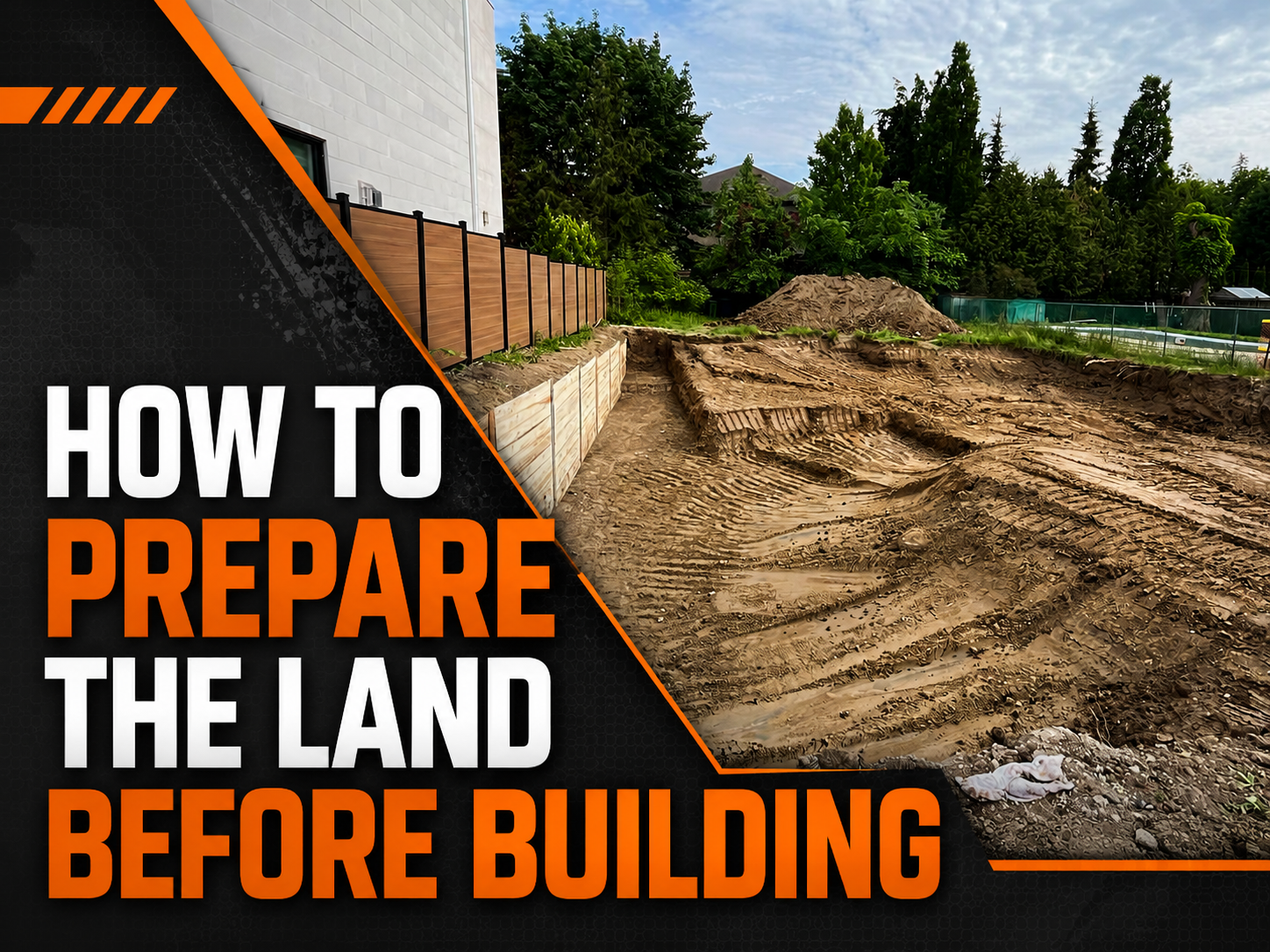
How to Prepare the Land Before Building
A step-by-step guide to site preparation before construction — from survey and clearing through excavation, shoring, grading, and drainage — from a licensed excavation company working across Toronto and the GTA.
Quick answer: how do you prepare land before building?
To prepare land before building, you follow six core steps: assess the site with a survey and soil review, secure permits and locate underground utilities, clear and demolish, strip topsoil and excavate to depth, install shoring for deep digs, and finally grade, compact, and manage drainage to leave a build-ready pad. In Toronto and the GTA, this process typically takes one to three weeks depending on lot size, access, and soil conditions.
Why Site Preparation Decides Your Whole Build
Everything you build sits on the ground you prepare. Skip a step — an untested soil, a missed utility, a lot that drains toward the foundation instead of away from it — and the cost shows up later as settlement, cracked concrete, water in the basement, or a stop-work order. Proper land preparation is not overhead; it is the insurance policy for every dollar you spend above grade.
Below is the sequence a professional excavation company follows to turn a raw or built-on lot into a stable, permitted, build-ready pad in Toronto and the GTA.
The 6 Steps to Prepare Land Before Building
Assess the Site & Order a Survey
Before any machine arrives, the lot is evaluated with a land survey and, where needed, a geotechnical (soil) report. This confirms property boundaries, soil type and load-bearing capacity, the water table, existing drainage patterns, and whether demolition or shoring will be part of the job. A number or a plan without this context is guesswork.
Secure Permits & Locate Utilities
Excavation, demolition, and grading generally require municipal permits. Just as critically, every underground utility — gas, water, hydro, telecom — must be located and marked before digging. In Ontario, locating buried services is a legal requirement and prevents dangerous, expensive strikes.
Clear & Demolish
Trees, brush, debris, and any existing structures or old foundations are removed so the site is clean and stable. On lots with a house or slab still standing, demolition happens first — ideally handled by the same team, so there is no gap between trades holding up the dig.
Strip Topsoil & Excavate
The topsoil is stripped and stockpiled, then the lot is excavated to the required depth for footings, foundations, or a basement. Soil is loaded into trucks, hauled off site, and disposed of properly. This is the phase where machine size and site access most affect the timeline and cost.
Install Shoring (If the Dig Is Deep)
For deep excavations — generally over 8 feet in Toronto — engineered shoring is installed to retain soil under pressure, protect neighbouring structures, and keep the site compliant. Deep urban lots almost always need it; shallow ones may not.
Grade, Compact & Manage Drainage
Finally, the lot is graded to the correct slope, the soil is compacted to reach its design load-bearing capacity, and drainage is set so water flows away from the future foundation. This last step is what actually hands off a build-ready pad to the foundation crew.

Pre-Construction Site Prep Checklist
Before the foundation crew shows up, a properly prepared lot should have all of the following in place:
- Survey & soil report completed and reviewed
- Permits approved and utilities located and marked
- Site cleared of vegetation, debris, and old structures
- Excavation to the correct depth, soil hauled and disposed
- Shoring installed where the excavation is deep
- Grading, compaction, and drainage complete — a stable, build-ready pad
Common Site Preparation Mistakes to Avoid
The most expensive problems on a build almost always trace back to a shortcut taken during preparation:
Skipping the soil report. Building on soil that can’t carry the load leads to settlement and cracked foundations. Test first.
Poor drainage and grading. A lot that slopes toward the house, not away from it, sends water straight to the foundation. This is one of the leading causes of basement flooding.
Under-compacting the soil. Loose fill compresses over time. Without proper compaction, slabs and foundations move.
Not locating utilities. Hitting a gas or hydro line is dangerous, illegal without a locate, and can shut a project down entirely.
Treating demolition and excavation as separate contracts. The gap between trades is where delays live. One team handling clearing, excavation, and shoring keeps the schedule tight.
Site Preparation Across Toronto and the GTA
Preparing land in a dense urban market is not the same as a rural lot — access is tighter, neighbours are closer, utilities are everywhere, and regulations are stricter. Wallace Excavation & Demolition handles clearing, excavation, shoring, and grading as one connected service across Toronto, Etobicoke, North York, Mississauga, Brampton, Vaughan, Markham, Richmond Hill, Burlington, and surrounding communities — so your project starts on ground you can actually build on.
Common Questions About Preparing Land
What are the steps to prepare land before building?
How long does site preparation take before construction?
Do I need a permit to prepare land for construction in Toronto?
Why is grading and soil compaction important before building?
Does Wallace Excavation & Demolition handle site preparation across the GTA?
Start Your Build on Solid Ground
From clearing and excavation to shoring and grading, Wallace Excavation & Demolition prepares your lot the right way. Send us your drawings or site details and we’ll review it before we quote.
Get a Free Quote from Wallace Excavation & Demolition