
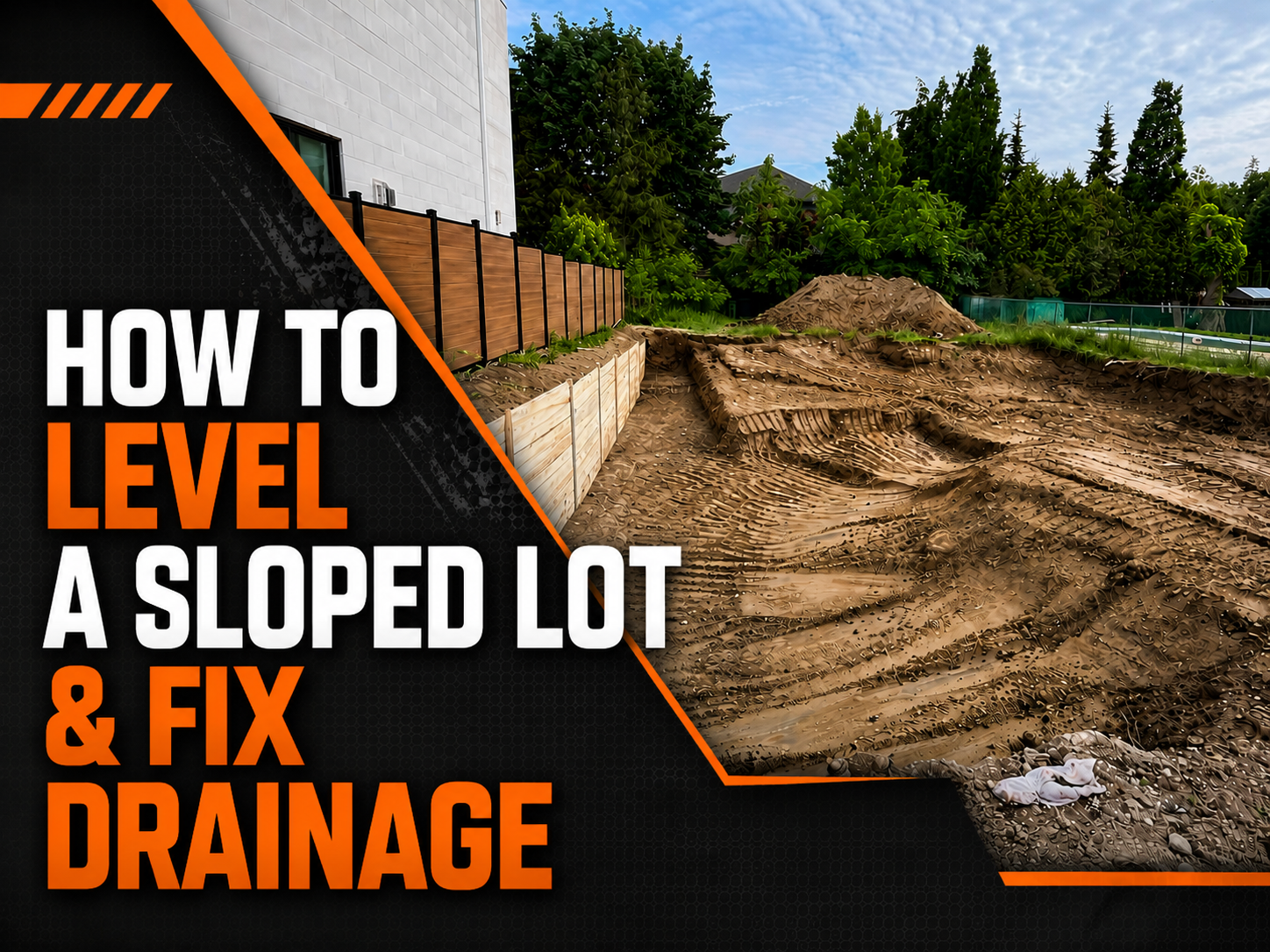
How to Level a Sloped Lot & Fix Drainage
A practical guide to grading a sloped property and solving the drainage problems that come with it — cut-and-fill, terracing, retaining walls, swales, and French drains — from a licensed excavation company across Toronto and the GTA.
Quick answer: how do you level a sloped lot and fix drainage?
To level a sloped lot, you survey the grade, then cut, fill, or terrace the soil to the target elevations, adding retaining walls where the slope is steep. Drainage is solved at the same time by grading the surface to slope away from structures at about 2%, then adding swales, French drains, catch basins, and downspout extensions so surface and subsurface water is directed off the property. Grading and drainage are one connected job — done together, not separately.
Why Slope and Drainage Must Be Solved Together
A sloped lot is not just an aesthetic problem — it is a water problem. Gravity pulls every rainfall and snowmelt downhill, and if the grade sends that water toward a foundation, a neighbour’s property, or a low spot that never drains, you get erosion, pooling, and eventually water where it does the most damage. Leveling the lot without fixing drainage simply relocates the problem.
That is why professional grading treats leveling and drainage as one job. Every cut, fill, and retaining wall is planned around where the water needs to go. Below is the process that turns a difficult slope into stable, usable, well-drained ground.
Four Ways to Level a Sloped Lot
There is no single “level a slope” method — the right approach depends on how steep the grade is, the soil, and how you want to use the space.
Cut
Soil is removed from the high side of the slope to lower it to the target grade. Best when there is excess material up top and you need to bring the level down.
Gentle to moderate slopesFill
Soil is brought in and compacted on the low side to raise it. Fill must be properly compacted in layers, or it will settle and undo the work later.
Filling low or sunken areasCut-and-Fill
Soil cut from the high side is used to build up the low side, balancing the lot with minimal soil hauled in or out. Often the most cost-efficient method.
Most residential slopesTerracing
The slope is cut into a series of level steps, each held by a retaining wall. Creates usable flat areas on steep grades and controls water at each level.
Steep slopesThe Step-by-Step Process
Survey the Slope & Map Water Flow
A topographic survey establishes the exact elevation change, and the site is walked to see where water currently flows and pools. You cannot fix drainage you haven’t mapped — this step decides everything that follows.
Choose Cut, Fill, Cut-and-Fill, or Terrace
Based on the grade and intended use, the leveling strategy is set. Steeper lots are almost always terraced; gentler ones are usually balanced with cut-and-fill.
Add Retaining Walls Where Needed
Retaining walls hold soil at each grade change, stop erosion, and create level, usable space. In most Ontario municipalities, walls above a set height require engineering and permits — and proper drainage behind the wall is essential so water pressure doesn’t push it out.
Excavate, Grade & Compact
Soil is moved to the target elevations, then graded to a controlled slope — roughly 2% (about 6 inches over 10 feet) away from structures — and compacted so the ground is stable and load-bearing.
Install Drainage Systems
The right combination is added for the site: swales to channel surface runoff, French drains to move subsurface water, catch basins at low points, and downspout extensions to carry roof water well away from the foundation.
Stabilize the Surface
The finished grade is protected with topsoil, sod, seeding, gravel, or hardscaping so the soil holds, water is absorbed or directed, and erosion is prevented long-term.

Matching the Drainage Fix to the Water Source
Drainage isn’t one solution — it’s choosing the right tool for where the water is coming from:
- Surface runoff → proper grading and swales (shallow channels that guide water along a planned path)
- Subsurface / groundwater → a French drain (perforated pipe in gravel that collects and redirects water underground)
- Low points that pool → a catch basin tied into a drainage line
- Roof water → downspout extensions that discharge well away from the foundation
- Steep, eroding slopes → retaining walls with drainage behind them
For a lot to drain properly, the ground should fall about 2% away from any structure — roughly six inches over the first ten feet. Too flat and water sits against the foundation; too steep and the soil erodes. Hitting that target across a sloped lot is exactly what skilled grading delivers.
Common Slope & Drainage Mistakes
Leveling without draining. Flattening a lot but ignoring where water goes just moves the flooding somewhere else.
Using uncompacted fill. Loose fill settles, and your level lot becomes uneven — often right after the first heavy rain.
Grading water toward the house or a neighbour. The slope must send water to a planned outlet, not to the nearest structure or property line.
Retaining walls with no drainage behind them. Water builds pressure behind the wall and pushes it out. Walls need weep holes and gravel backfill.
Skipping permits. Grading and taller retaining walls usually need municipal approval in the GTA — skipping it risks fines and rework.
Grading & Drainage Across Toronto and the GTA
Sloped urban lots come with tight access, close neighbours, and strict municipal grading and drainage rules. Wallace Excavation & Demolition handles slope grading, retaining walls, and drainage as one coordinated service across Toronto, Etobicoke, North York, Mississauga, Brampton, Vaughan, Markham, Richmond Hill, Burlington, and surrounding communities — so your lot ends up level, stable, and draining exactly where it should.
Common Questions About Grading & Drainage
How do you level a sloped lot?
What is the best way to fix drainage on a sloped property?
What slope should a yard have for good drainage?
Do I need a permit to grade a sloped lot in Toronto?
Does Wallace Excavation & Demolition handle grading and drainage?
Level It Right. Drain It Right.
From cut-and-fill and terracing to retaining walls and drainage systems, Wallace Excavation & Demolition solves slope and water together. Send us your lot details and we’ll review before we quote.
Get a Free Quote from Wallace Excavation & Demolition