
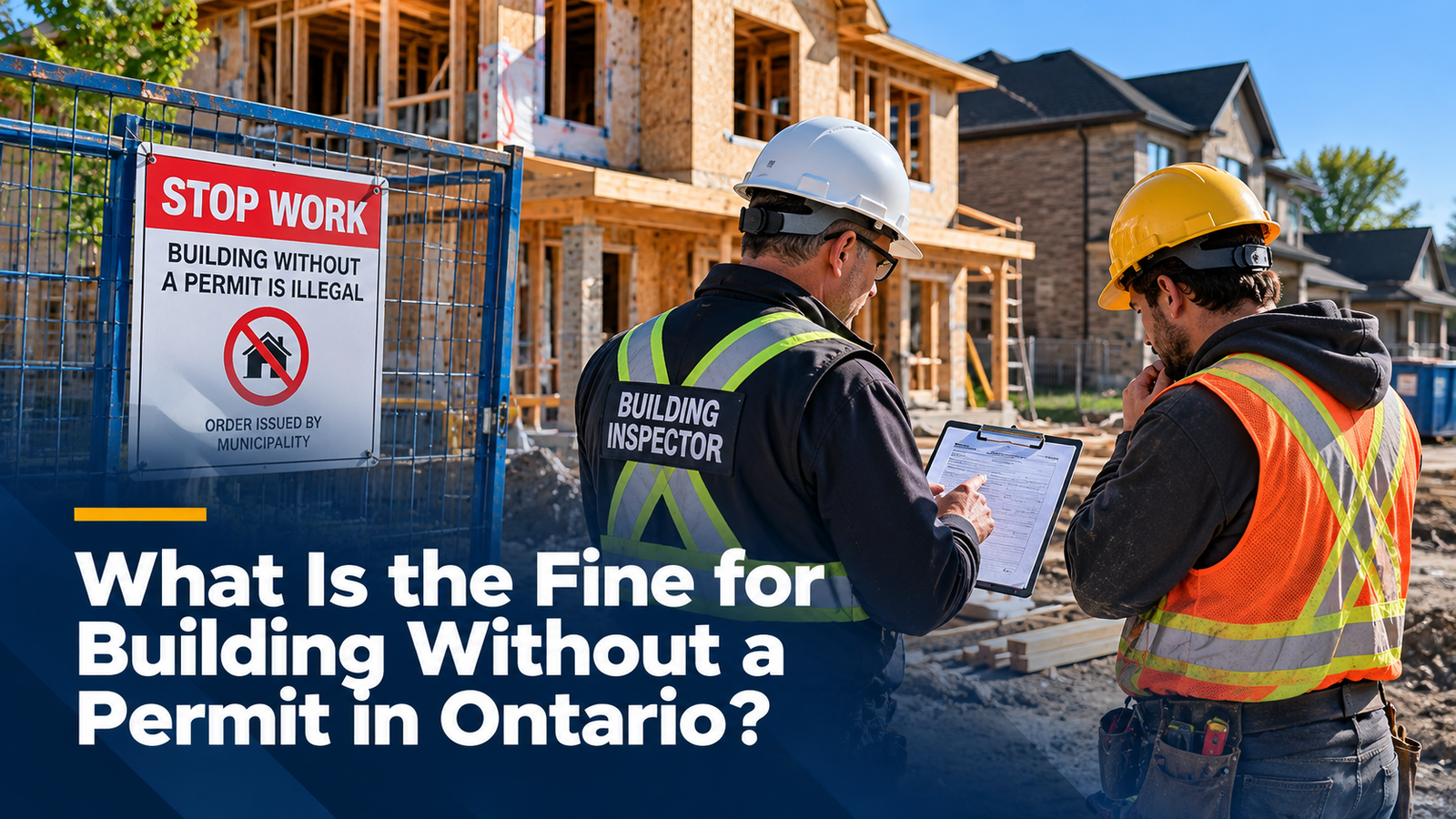
What Is the Fine for Building Without a Permit in Ontario?
The fine is only the first line of the bill. Here is what Ontario law actually allows, what Toronto adds on top, and why the building permit is the cheapest part of any project.
Quick answer: how big is the fine?
Under Ontario’s Building Code Act, an individual can be fined up to $50,000 for a first offence and up to $100,000 for a repeat offence. A corporation can be fined up to $500,000 for a first offence and up to $1,500,000 for a repeat. Those are court maximums, and the fine is rarely the biggest cost. A stop-work order, an extra permit fee, tearing out finished work and, in serious cases, a court-ordered demolition cost far more than the permit ever would have.
The Fines Under Ontario’s Building Code Act
Building without a required permit is an offence under the Building Code Act, 1992, the provincial law that every municipality in Ontario enforces. It applies the same way in Toronto, Mississauga, Vaughan or anywhere else in the province. The maximums depend on who is charged and whether there is a prior conviction.
| Who is charged | First offence (maximum) | Subsequent offence (maximum) |
|---|---|---|
| Individual (homeowner) | $50,000 | $100,000 |
| Corporation (developer, builder, company) | $500,000 | $1,500,000 |
Two details matter here. First, a “subsequent” offence means any earlier conviction under the Act anywhere in Ontario, not just on the same property. Second, ignoring an order from the City is its own offence, and fines for continuing non-compliance can be added on top, up to $10,000 for each day the problem continues after the deadline in the order.
Judges set the actual amount, and real-world penalties for a single violation are usually well below the maximums. That is not the comfort it sounds like. The fine is the smallest part of what building without a permit costs.
The bottom line
The fine is a ceiling set by the court. The real cost is everything that happens before and after it: work stops, fees go up, and finished construction may have to come out.
What It Costs Beyond the Fine
Most homeowners who get caught never see a courtroom. They deal with the building department directly, and that process is expensive enough on its own.
An order to stop work, then an order to comply
When an inspector finds work that needs a permit and does not have one, Toronto Building can issue a stop-work order. All construction halts while the property owner either applies for a permit or removes the structure. The clock on your project, your crew and your financing keeps running while nothing gets built.
An extra fee in Toronto
The City of Toronto charges a “work without permit” administrative fee equal to 50 percent of the permit fees for the project, with a minimum and maximum that the City updates periodically. The normal permit fees and processing times still apply on top of it.
Opening up and redoing finished work
Permitted work is inspected at set stages, before footings are poured, before walls are closed in, before backfill goes on. Work done without a permit skips every one of those checkpoints. An inspector can require you to uncover what is already built so it can be examined, and anything that does not meet the Ontario Building Code has to be corrected, sometimes with more structural or mechanical work than you originally planned.
Court-ordered demolition
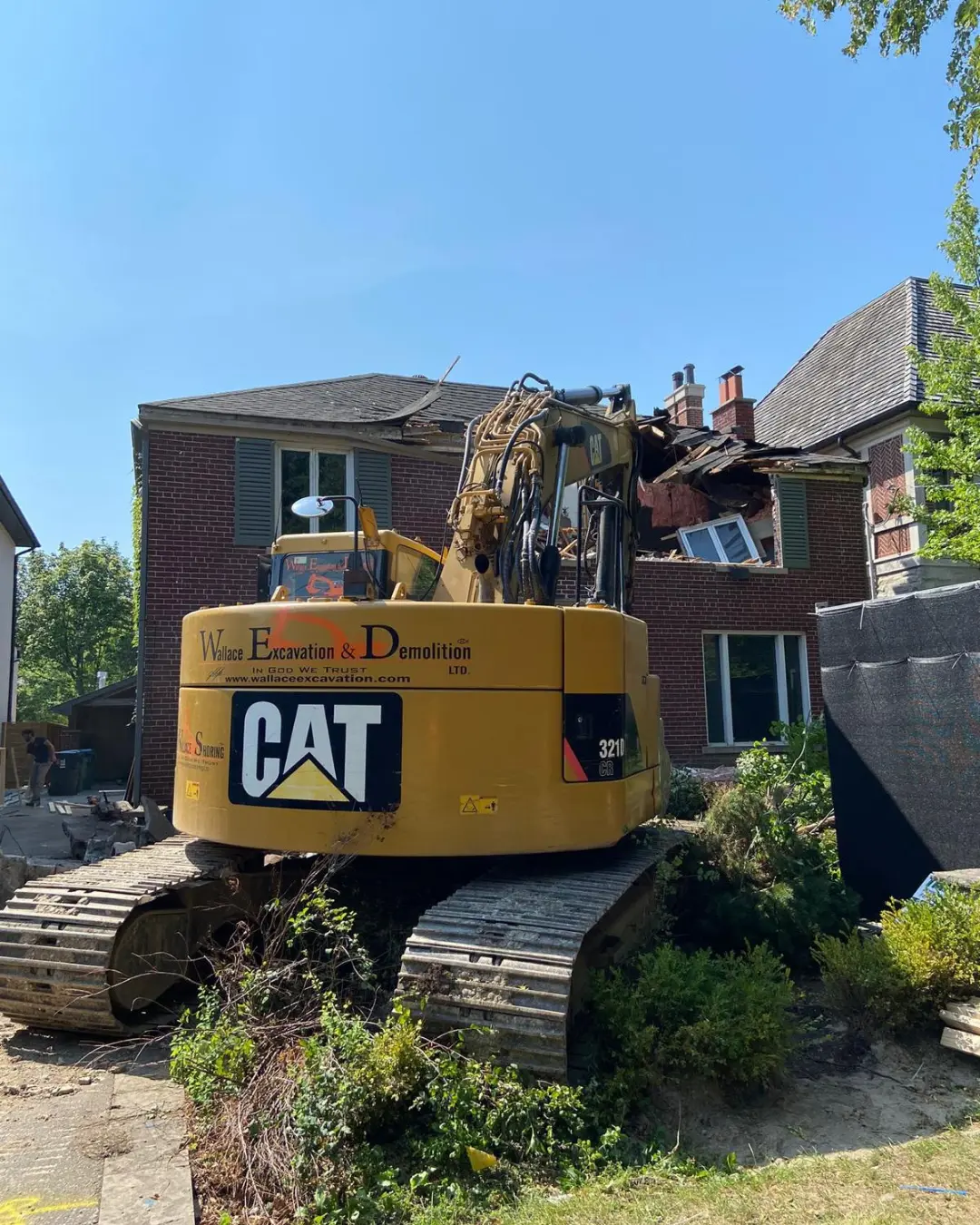
Section 38 of the Building Code Act lets a municipality ask the Superior Court of Justice to order the removal or demolition of a building, or part of one, built without a required permit. It is not the usual outcome, but it is on the table, and Ontario courts have ordered owners to tear down substantial above-grade construction that went ahead without valid permits.
Trouble when you sell or make a claim
Unpermitted work tends to surface at the worst moment: a buyer’s lawyer asks for permit records, an appraiser notices an addition that is not on file, or an insurer reviews a claim on a structure that was never inspected. Any of those can delay a sale, reduce the price or leave you paying a loss out of pocket.
| Consequence | Who imposes it | What it means for you |
|---|---|---|
| Fine on conviction | Provincial Offences Court | Up to $50,000 / $100,000 (individual) or $500,000 / $1,500,000 (corporation) |
| Stop-work order | Municipal building department | Project halts until a permit is issued or the work is removed |
| Work-without-permit fee | City of Toronto | 50% of the project’s permit fees, added to the normal fees |
| Order to uncover or comply | Municipal building department | Finished work opened up, inspected and corrected at your cost |
| Removal or demolition order | Superior Court of Justice | Unpermitted construction removed |
| Sale and insurance problems | Buyers, lenders, insurers | Delays, price reductions, denied claims |
Who Is Responsible: You, Not Your Contractor
This is the part that surprises people most. In Ontario, getting the permit is generally the property owner’s responsibility, even when a builder or contractor is doing the work. Saying “my contractor told me we did not need one” does not move the charge off the owner, and a contractor who skips the permit can face charges too.
That is why the first question to put to any contractor is simple: who applies for the permit, and who pays the fees? A written answer before work starts protects you. A vague one is a warning.
Why the Permit Exists in the First Place
It is easy to treat a permit as paperwork. For excavation and demolition work, it is closer to a safety system with four jobs.
It protects people
- Inspections catch unsafe structure, shoring and excavation before they become a collapse
- Utilities are located and formally disconnected before the machine starts
- Hazardous materials such as asbestos are identified before demolition, not during it
It protects your neighbours
- Excavation next to an occupied house can undermine its foundation if it is not planned properly
- Setbacks, grading and drainage are checked so water does not end up on the next lot
- City curbs, sidewalks and trees are protected by deposits and conditions
It protects your investment
- The City reviews the plans against zoning and the Ontario Building Code before you spend money building
- A closed permit is a paper trail a buyer, lender or insurer can rely on
- Problems are caught when they cost hundreds to fix, not tens of thousands
It protects your schedule
- A stop-work order halts every trade on site at once
- Sequencing the permit first avoids paying a crew to wait
- Inspections happen at planned stages, not after the walls are closed
Which Excavation and Demolition Work Needs a Permit?
The exact rules depend on the municipality, the structure and the scope, so confirm the specifics with your local building department. As a general guide for the kind of work Wallace Excavation & Demolition does, these jobs usually involve a permit:
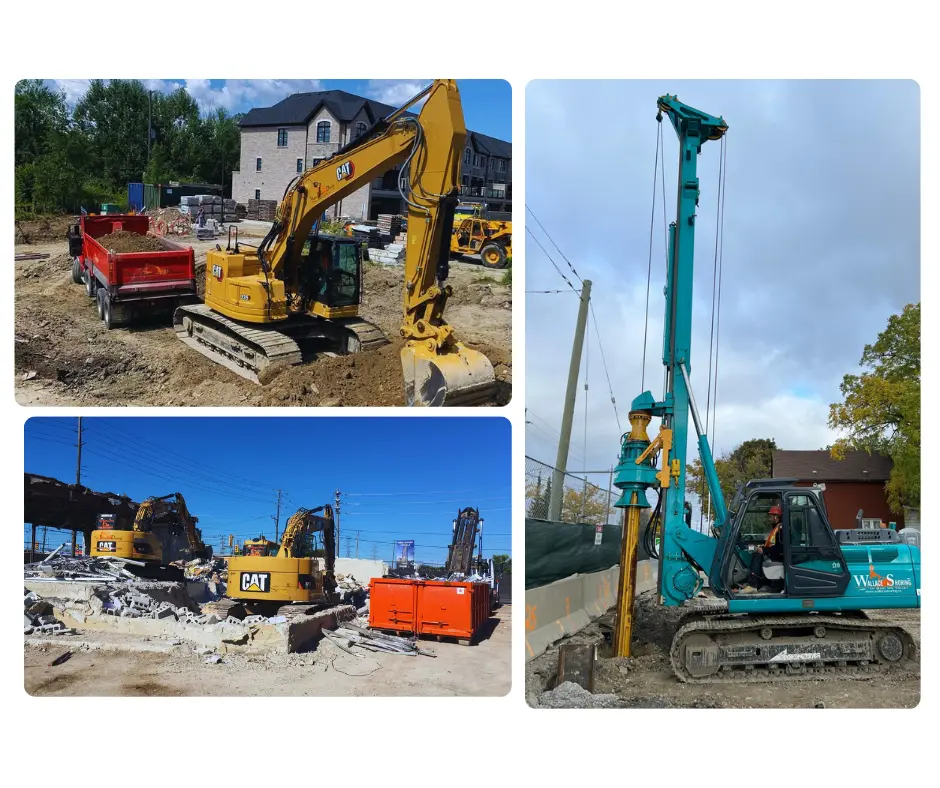
- Demolishing a house or other structure. In Toronto, structural demolition requires a permit from Toronto Building. On a teardown and rebuild, it is normally reviewed alongside the replacement building permit.
- Excavation for a new foundation or addition. This is typically covered by the building permit for the new construction.
- Shoring and underpinning. Work that supports soil or an existing structure next to a deep excavation affects safety and neighbouring properties, and is reviewed accordingly.
- Basement lowering and new basement entrances. These change the structure and drainage of the building.
Related requirements often travel with the permit: a designated substances report, formal utility disconnections, a damage deposit for municipal property, tree protection and, for listed or designated properties, heritage clearance. If you are unsure whether your project needs a building permit, ask before you start. The call costs nothing.
A note on accuracy
Fine maximums, fee percentages and permit requirements change. This article is general information, not legal advice. Confirm the current figures and rules with your municipal building department or a lawyer before you commit to a project.
Already Built Without a Permit? How to Fix It Before You Are Fined
If work has already been done without a permit, the worst move is to wait and hope nobody notices. Unpermitted work tends to surface at the worst possible time: a neighbour complaint, a home inspection before a sale, or an insurance claim after a flood or fire. Dealing with it on your own terms almost always costs less than the fine for building without a permit in Ontario, and far less than a court order.
- Stop and document. Pause any further work, then photograph and list everything that was built, dug or removed, with dates and the names of the trades involved.
- Talk to the building department. Every Ontario municipality accepts building permit applications for work that has already started. In Toronto, that is Toronto Building. Expect the regular building permit fee plus any extra fee the city charges for starting early.
- Get drawings and engineering. The application needs drawings that show the work as built. For excavation, shoring, underpinning or structural changes, a professional engineer usually has to review and sign off.
- Expect to open things up. Inspectors cannot approve what they cannot see. Drywall, flooring or backfill may need to come out so footings, drainage, waterproofing and structure can be checked.
- Correct what does not comply. Anything that fails inspection has to be repaired or rebuilt to the Ontario Building Code before the building permit can be closed.
Coming forward does not erase every risk, but it moves you from enforcement to compliance. Cities generally focus on getting the work made safe and legal, and an owner who applies voluntarily is in a much stronger position than one who waits for an inspector to knock. If the unpermitted work involves excavation, a basement, a demolition or shoring, Wallace Excavation & Demolition can assess the site and work with your engineer to bring it up to code.
Why Hire Wallace Excavation & Demolition
A permit protects you from the City. The right contractor protects you from everything else, including the quote that looks cheap because it left out the paperwork. Here is how Wallace Excavation & Demolition approaches it.
The scope is written down before work starts
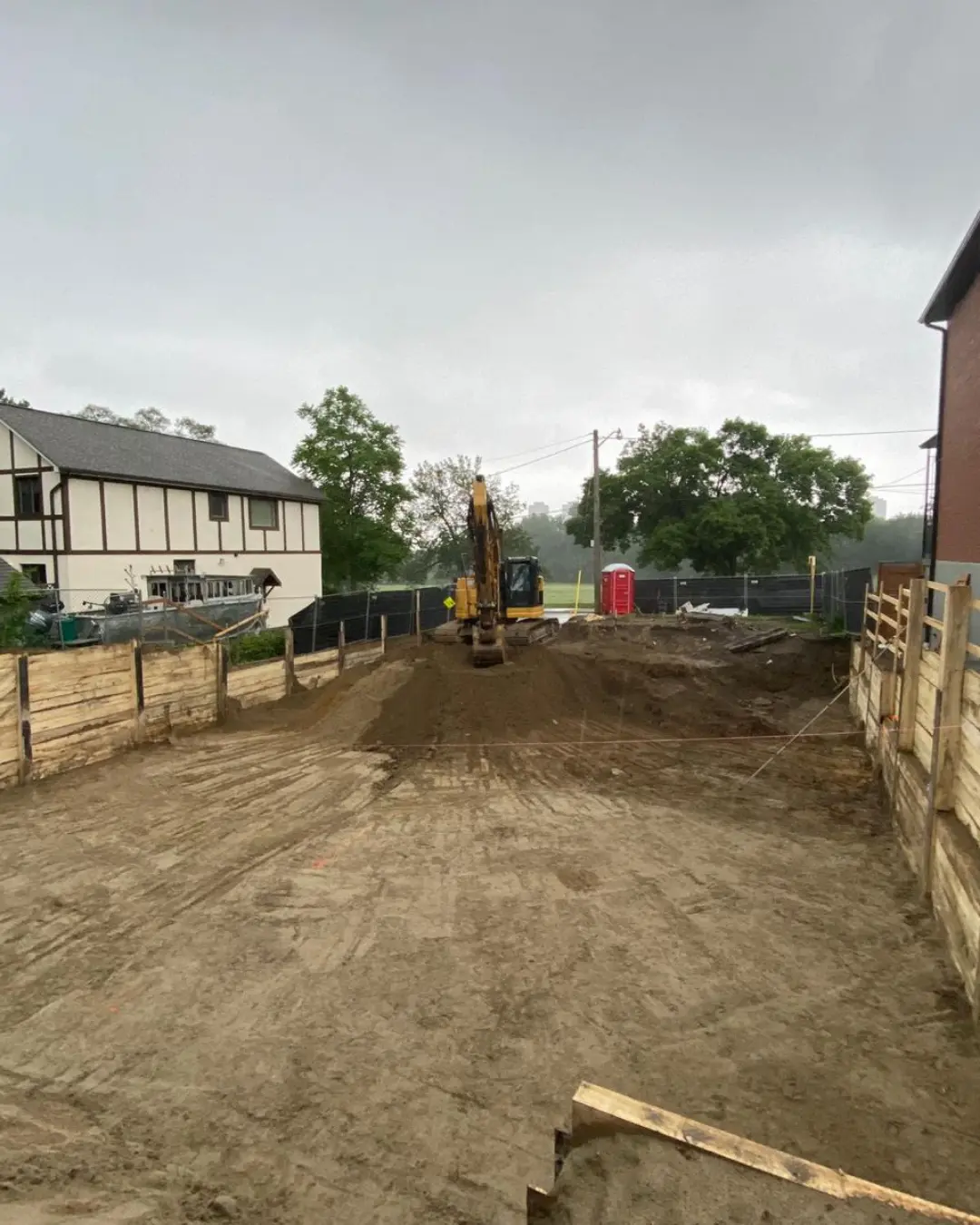
Wallace Excavation & Demolition names the structure, the foundation, the disposal and the final grade in writing, so you can see exactly what is included and what is not. It is the same discipline that keeps a project inside its permit: nothing is left as “as required” to be discovered later.
The permit and approvals come first
On a demolition or excavation job, the permit, the utility disconnections and the designated substances report all have to be finished before the machine arrives. Wallace Excavation & Demolition builds the schedule around them, because the paperwork, not the equipment, is almost always what sets your start date. Ask who applies and who pays the fees, and get the answer in the quote.
Work that holds up to inspection
Shoring, excavation and foundation removal are the stages inspectors care about most, and the stages where shortcuts are most expensive. Wallace Excavation & Demolition is licensed and insured, and works in the order that inspections expect: setup, takedown, below-grade removal, disposal, then backfill and grading.
One team for the full excavation scope
Demolition, excavation and shoring are connected, and a gap between them is where cost overruns hide. Having a single contractor responsible for the sequence keeps the schedule, the permit conditions and the site in step.
Permit-Ready Excavation and Demolition Across the GTA
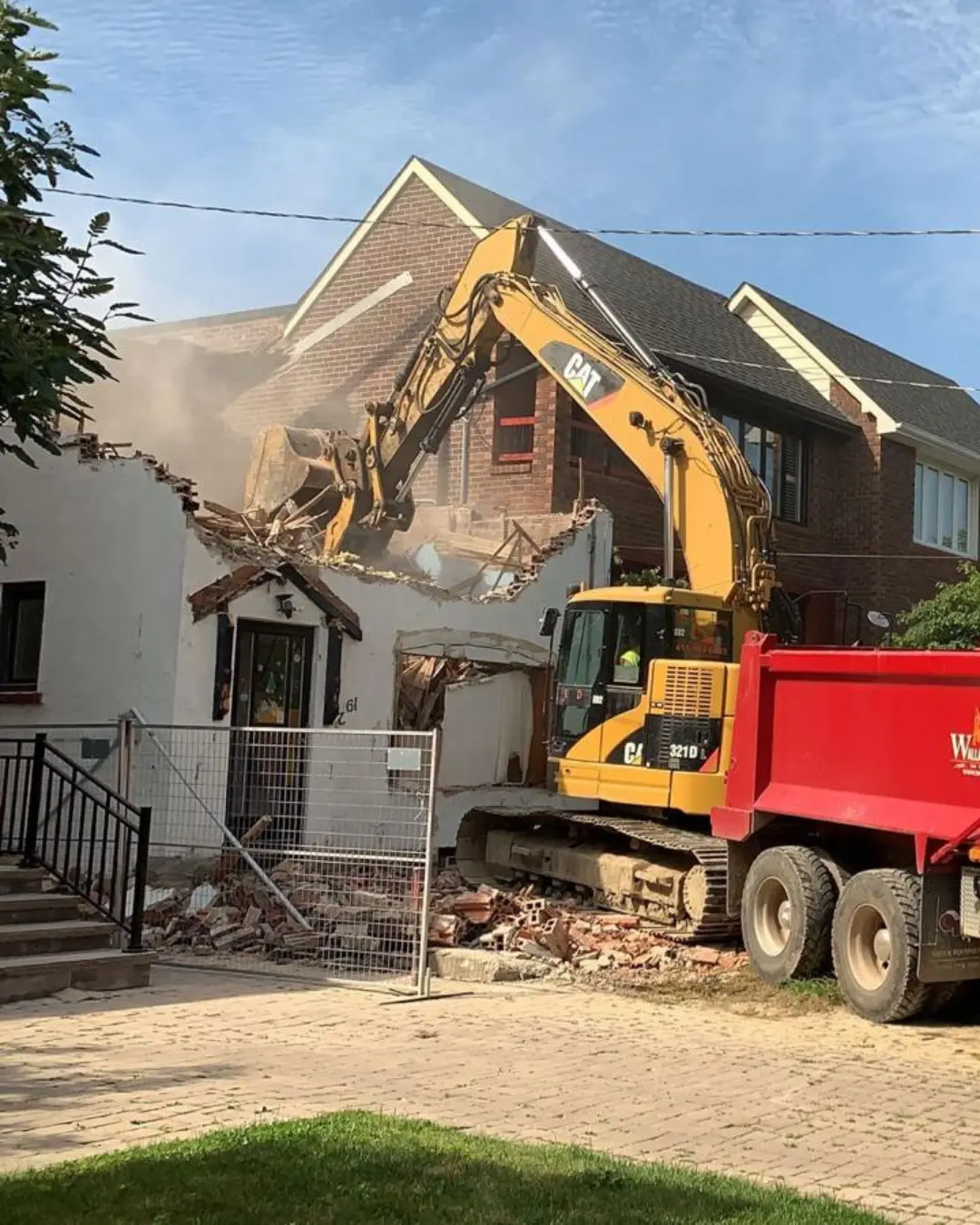
Wallace Excavation & Demolition serves residential and commercial clients across Toronto, Etobicoke, North York, East York, Mississauga, Brampton, Vaughan, Markham, Richmond Hill, Burlington and Milton. Each municipality runs its own building department, with its own application process and timelines, so the first step on every project is confirming what that city requires for your address.
In This Guide
Planning Excavation or Demolition?
Send us the address and what you intend to build. You will get a written scope naming exactly what is included, so nothing is left to discover later.
Request a Free QuoteContact Wallace Excavation & Demolition
- 📞 Cell: (416) 989-6403
- ☎️ Office: (416) 755-3221
- ✉️ estimator@wallaceexcavation.com
- 📍 168 Clearbrooke Cir, Etobicoke, ON
Common Questions About Building Permits in Ontario
What is the fine for building without a permit in Ontario?
Under the Building Code Act, 1992, an individual can be fined up to $50,000 for a first offence and up to $100,000 for a subsequent one. A corporation can be fined up to $500,000 for a first offence and up to $1,500,000 for a subsequent one. Failing to comply with an order can add further fines for each day it continues. The court sets the actual amount, and the real cost of a violation usually includes more than the fine itself.
Can the City make me tear down work built without a permit?
Yes, in some cases. A municipality can ask the Superior Court of Justice to order the removal or demolition of construction built without a required permit. More commonly, the City issues an order requiring you to stop work and then either obtain a permit or remove the work, and it can require you to uncover finished work for inspection.
What extra fee does Toronto charge for starting work without a permit?
Toronto charges a work-without-permit administrative fee equal to 50 percent of the permit fees for the project, with a minimum and maximum that the City updates periodically. It is added to the normal permit fees, and the normal processing time still applies. Confirm the current amounts with Toronto Building.
Is the owner or the contractor responsible for getting the permit?
In general, the property owner is responsible for making sure a required permit is obtained, even when a contractor does the work. A contractor can also face charges for work done without a permit. Ask any contractor in writing who applies for the permit and who pays the fees before work starts.
Do I need a permit to demolish a house in Toronto?
Yes. Toronto Building requires a demolition permit for structural demolition, and on a teardown and rebuild the application is normally reviewed together with the replacement building permit. A designated substances report, utility disconnections and a damage deposit are part of the process. Wallace Excavation & Demolition can quote the demolition and excavation scope once you share the address and your plans.
Can I get a permit after the work has already started?
Often you can apply, but work must stop while the application is reviewed, and the extra fee applies in Toronto. The City reviews the plans against current zoning and the Ontario Building Code, and may require finished work to be opened up for inspection or corrected. If the work cannot be approved, you may have to remove it.
Does Wallace Excavation & Demolition work outside Toronto?
Yes. Wallace Excavation & Demolition serves Toronto, Etobicoke, North York, East York, Mississauga, Brampton, Vaughan, Markham, Richmond Hill, Burlington and Milton, for both residential and commercial excavation and demolition.
Get a Precise Excavation or Demolition Quote
Starting your project and need an accurate quote with the scope, the permit and the schedule laid out clearly? Get in touch with the Wallace Excavation & Demolition team today for a no-obligation estimate.
Get a Free Quote from Wallace Excavation & DemolitionToronto · Etobicoke · North York · East York · Mississauga · Brampton · Vaughan · Markham · Richmond Hill · Burlington · Milton · GTA
Wallace Excavation & Demolition — Licensed & Insured · 168 Clearbrooke Cir, Etobicoke, ON M9W 2G1
Office: (416) 755-3221 · Cell: (416) 989-6403 · estimator@wallaceexcavation.com