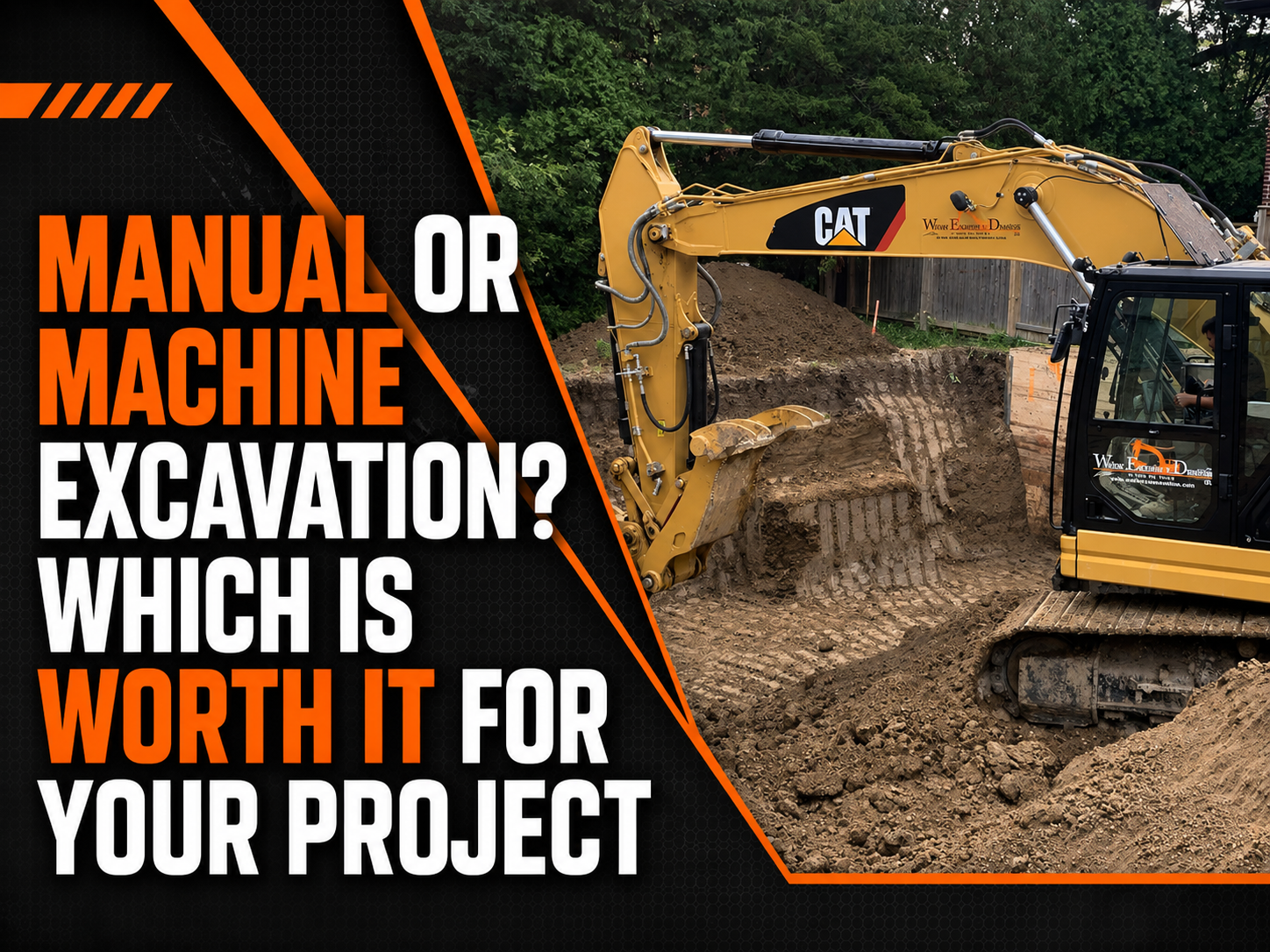
Manual or Machine Excavation? Which Is Worth It for Your Project
Hand digging with a crew, or a mini excavator on your lot? Here is how the two compare on time, cost, and precision — and how to know which one actually saves you money.
Quick answer: manual or machine excavation?
For almost any project of meaningful volume, machine excavation wins on time and cost — a compact or mini excavator moves in an hour what a crew with shovels moves in a day. Manual excavation is reserved for small, shallow, or delicate work: digging beside marked utilities, working under an existing structure, or fine finishing where precision beats speed. The good news for tight urban lots: mini excavators fit where large machines can’t, so you rarely have to fall back on hand digging just because access is limited.
Manual vs. Machine: The Comparison
The honest way to choose is to compare the two on the factors that actually affect your budget and schedule — time, cost, precision, access, and safety. Here is how they stack up:
| Factor | Manual Excavation | Machine Excavation |
|---|---|---|
| Speed | Slow — a crew moves limited volume per day | Fast — moves in an hour what hands move in a day |
| Cost per cubic meter | High on any real volume (labour-intensive) | Low — productivity drives the unit cost down |
| Precision / finishing | Excellent for fine, delicate, careful work | Very good; final hand-finishing sometimes added |
| Access to tight spaces | Fits anywhere a person fits | Mini excavators fit ~3–4 ft gates & backyards |
| Work near utilities | Safer right beside marked lines | Machine keeps clearance; hand-dig at the line |
| Best for | Very small, shallow, or delicate jobs | Most residential & commercial excavation |
On volume, machine excavation almost always wins. Manual excavation is not a cheaper alternative — it is a specialist tool for the specific cases where a machine can’t fit or shouldn’t be used. The real skill is knowing when to switch between them, and often the answer is both: machine for the bulk, hands for the finish.
Time and Cost: Why the Machine Usually Wins
Excavation is priced on how much soil moves per day. A crew with shovels and a wheelbarrow has a hard ceiling on daily output — no matter how skilled, there are only so many cubic meters a person can move. A machine changes the math entirely: it digs, loads, and clears in a fraction of the time.
That speed is why machine excavation usually costs less per cubic meter even after equipment and operator costs. A job that takes a crew a week of labour might be a day or two with a compact excavator — fewer days on site, fewer labour hours, less exposure to weather delays. Manual excavation only competes on the smallest jobs, where the time and cost of bringing a machine to site isn’t justified.
Tight Spaces: Where Mini Excavators Change Everything
The old reason to hand-dig was access — big machines simply couldn’t reach a backyard or squeeze down a side yard. Mini and compact excavators removed that barrier. Many models fit through a standard gate of roughly three to four feet, turn in confined spaces, and reach backyards, rear additions, and tight urban infill lots where a full-size excavator would never go.
That means for most Toronto and GTA properties, limited access is no longer a reason to fall back on shovels. A mini excavator brings machine speed and cost-efficiency into spaces that used to be hand-dig only — the best of both worlds.

When to Choose Each Method
Choose Machine Excavation
- Foundations, basements, and footings
- Any job with meaningful soil volume
- Rear additions and backyards (mini excavator)
- Tight urban lots with gate-width access
- When speed and cost per cubic meter matter
Choose Manual Excavation
- Very small or shallow digs
- Right beside marked underground utilities
- Inside or under an existing structure
- Fine finishing and precise trimming
- Spots a machine genuinely cannot reach
Near marked gas, water, or hydro lines, careful hand digging is often required by the utility locate itself — a machine keeps clearance and the crew finishes by hand at the line. Choosing the method isn’t only about cost; it’s about digging safely and legally.
Excavation the Right Way Across Toronto and the GTA
The best outcome doesn’t come from picking “manual” or “machine” as a rule — it comes from matching the method and machine size to the site. Wallace Excavation & Demolition does exactly that: compact and mini excavators on tight urban lots, full-size machines on high-volume digs, and careful hand work where precision or utility clearance demands it — across Toronto, Etobicoke, North York, Mississauga, Brampton, Vaughan, Markham, Richmond Hill, Burlington, and surrounding communities.
Common Questions About Manual vs. Machine Excavation
Is manual or machine excavation better?
When is hand digging necessary instead of a machine?
Can a mini excavator fit in a backyard?
Does machine excavation save money over manual labour?
Does Wallace Excavation & Demolition handle both manual and machine excavation?
Get a Precise Excavation Quote
Starting your project and need an accurate quote for excavation and site preparation? Get in touch with the Wallace Excavation & Demolition team today for a no-obligation estimate.
Get a Free Quote from Wallace Excavation & Demolition