
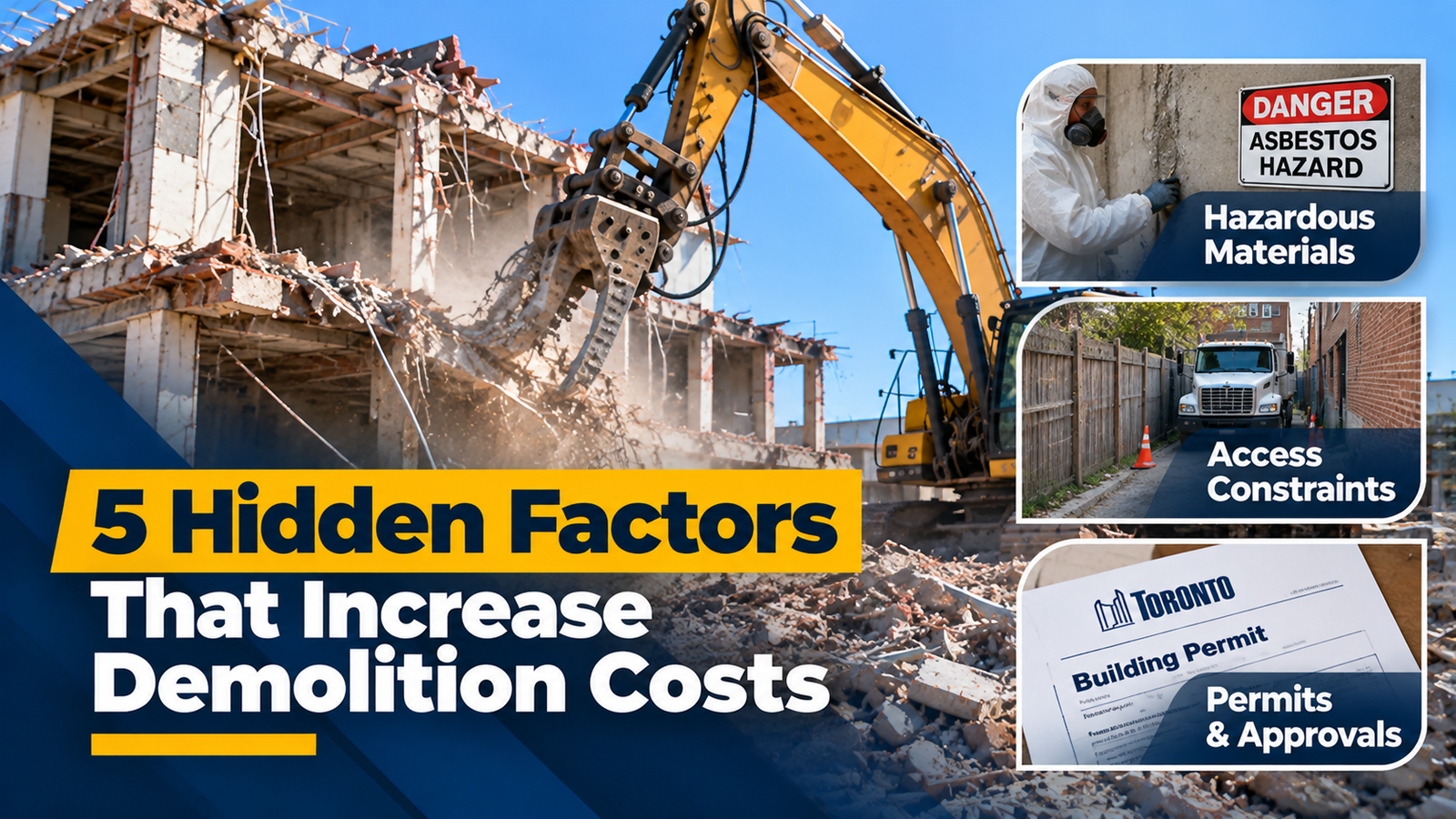
Demolition Costs · Toronto & GTA
5 Hidden Factors That Increase Demolition Costs (Hazardous Materials, Access & Permits)
The demolition costs that are missing from a first quote, why they appear, and how to bring them into the price before the machine arrives.
In this guide
Quick answer: what are the hidden demolition costs?
Five hidden demolition costs rarely appear on a first quote: hazardous materials inside the building, tight access and street use, permits and utility disconnections, what is buried under the lot, and disposal and sorting. All five can be investigated before work starts, so they should become written lines in your estimate instead of change orders.
Wallace Excavation & Demolition estimates demolition costs across Toronto and the GTA from an on-site review. The standard inputs, such as the size of the building and the demolition method, are covered in our guide to how demolition cost is calculated. This article covers what a first quote tends to miss.
A note on accuracy. Regulations, City fees and permit requirements change from time to time. This article is general information, not legal or environmental advice. Confirm the current rules and fees with Toronto Building, the Ontario Ministry of Labour and a qualified environmental consultant.
The 5 Hidden Factors That Raise Demolition Costs
Hazardous materials hidden inside the building
Older buildings can contain materials that are safe while they are left alone and dangerous once a machine breaks them apart. Ontario regulates eleven designated substances, including asbestos, lead, mercury and silica, and they turn up in places an owner would never think to look: insulation, floor tiles, pipe wrap, plaster and old paint.
The duty to find them falls on the owner. Under section 30 of the Occupational Health and Safety Act, the owner of a project, including a residential owner, must determine which designated substances are present and give that list to the contractors who are pricing the work. For asbestos, Ontario Regulation 278/05 adds that the owner must check before requesting tenders or arranging a demolition, and that asbestos likely to be disturbed is removed, as far as practicable, before demolition goes ahead. Toronto Building’s demolition application points applicants to the same duty.
Each step costs money: a survey by a qualified consultant, abatement before the machine arrives, regulated disposal of the waste and the extra days on the schedule. A quote that does not mention any of it has either assumed the building is clean or left the question for later.
Tight access and street use
A lot with no side access, a house sharing a wall with its neighbour, overhead wires or mature trees can rule out the biggest machine on the truck. Smaller equipment, more hand work and more truck trips all add days, and days drive demolition costs because they are what a crew charges for.
In Toronto, access also has a permit and a deposit attached. A Street Occupation Permit is needed before a demolition starts if you will use the boulevard, sidewalk, roadway or public lane, and that includes a disposal bin or equipment parked past your property line. The permit is charged by area and by time, so a slow job costs more. The City also takes a Municipal Road Damage Deposit as a guarantee against damage to the curb, sidewalk, road and boulevard, tracking mud onto the street, or failing to clear snow and ice from the sidewalk. The site normally needs a construction fence as well.
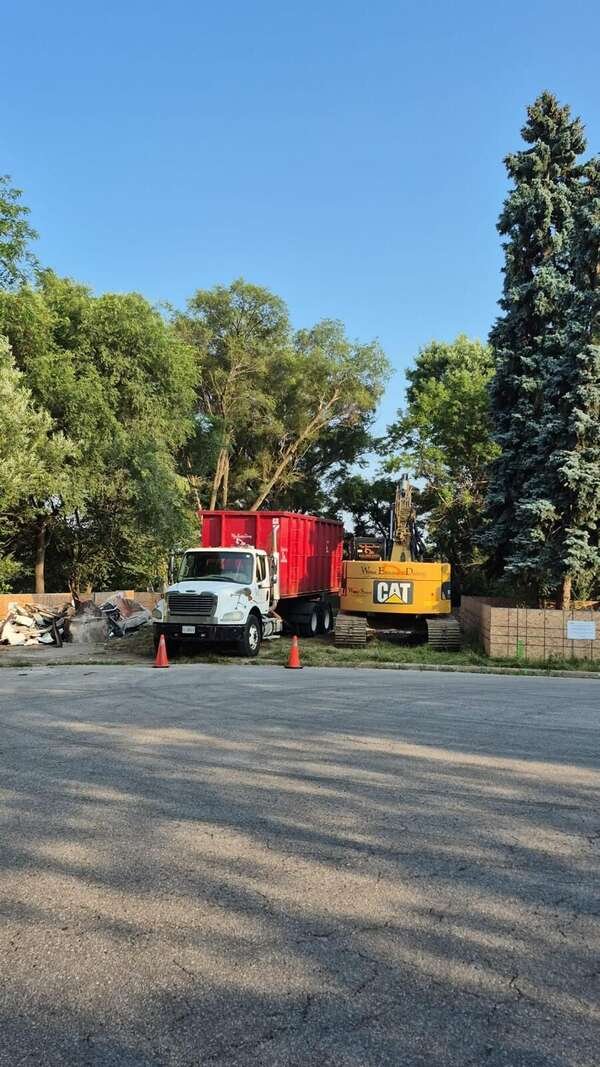
Disposal truck and excavator set up beside the street on a demolition job executed by Wallace Excavation & Demolition. Permits, deposits and utility disconnections
The permit is only the headline fee. For a residential demolition with a replacement house, Toronto asks for a survey or grading plan, the application form, an infill public notice declaration, the owner’s acknowledgement of demolition control conditions, the road damage deposit form and a tree declaration form. The base permit fee is calculated per square metre of the building being demolished, and the City’s 2026 fee schedule lists a separate environmental review fee of $1,030.99 in addition, so ask whether your file triggers that review.
The demolition control conditions are worth reading before you sign them. They can include a deadline for building the replacement, which turns a demolition schedule into a construction schedule.
Utility disconnections are the quiet delay. Gas, electricity, water and sewer services must be cut off before the building comes down, and some providers want the demolition permit in hand before they will disconnect at the main. Each wait is paid for in carrying costs while the house stands empty.
What is buried under the lot
The surface tells you what is there now, not what was there before. Old slabs, footings deeper than the plans suggest, cisterns and abandoned septic tanks can all turn up, and each one is extra hauling and extra machine time.
The costliest find is an abandoned underground oil tank. Under Ontario’s Fuel Oil Code and Liquid Fuels Handling Code, an underground tank has to be removed within two years of going out of use, unless a variance is granted. That is specialist work, followed by soil testing, and contaminated soil can multiply the bill. An oil fill or vent pipe on an outside wall, or abandoned oil lines in the basement, are the usual warning signs.
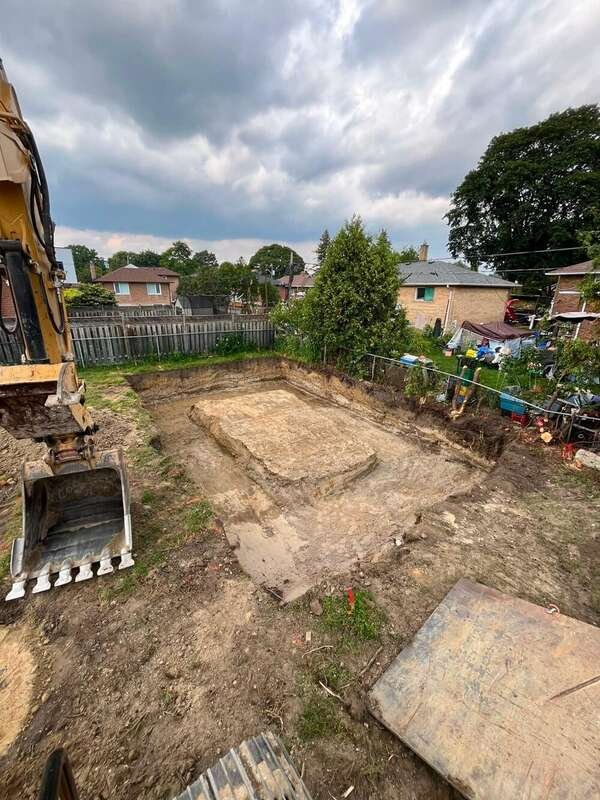
Old concrete slab exposed in the excavation, work executed by Wallace Excavation & Demolition. Disposal, sorting and haulage
A house does not leave the site as one material. Brick, concrete, wood, metal and drywall are separate streams, and regulated waste such as asbestos has to be handled apart from ordinary debris. A load that is sorted on site is generally cheaper to place than a mixed one, and every extra truck trip adds to the haulage line.
Soil is its own category. Once the foundation comes out, any soil that leaves the lot is regulated in Ontario as excess soil, which our guide to preparing land and digging footings explains. Ask whether disposal is a fixed price or charged by the load, because a heavy building can change the number.
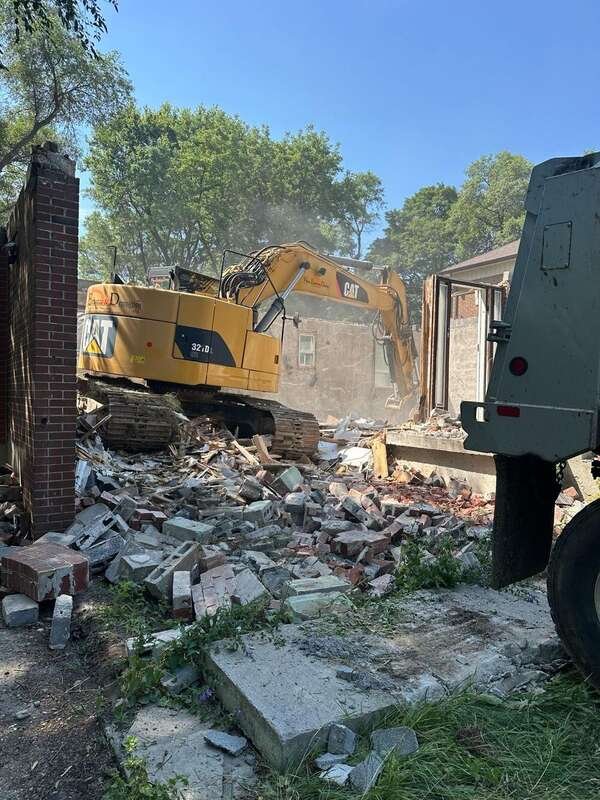
Brick rubble from a house demolition being worked through, executed by Wallace Excavation & Demolition.
Questions to Put in Writing Before You Sign
Each factor above becomes a question for the contractor. Get the answers in the quote itself:
- Does the quote assume a designated substances survey, and who pays for abatement if one is needed?
- How will equipment, bins and trucks reach the site, and who applies for and pays the Street Occupation Permit and road damage deposit?
- Which permits, deposits and utility disconnections are included, and who requests them?
- Is foundation removal included, and what is the price if a tank, slab or cistern is found?
- Is disposal a fixed price or by the load, and how are sorted and mixed loads handled?
For a Toronto example of the full sequence, see our case study on what a full residential teardown actually involves, and our guide to the fine for building without a permit in Ontario if a permit question is still open.
Common Questions About Demolition Costs
Who pays for hazardous material removal, the owner or the contractor?
Usually the owner, because the law makes the owner responsible for identifying designated substances before the work is tendered. Abatement is typically priced as part of the project, so confirm in the contract who is paying and whether it is included in the quote.
What happens if hazardous materials are found during the demolition?
Work in the affected area stops until the material has been identified and handled properly, because asbestos that is likely to be disturbed has to be removed before demolition continues. The schedule shifts and the price normally changes through a written change order.
Can I demolish a house in Toronto without building a replacement?
The City’s residential demolition guide covers demolitions with a replacement building on the same site. If no replacement is planned, Toronto Building directs you to contact the district office responsible for your property before you apply.
Are there any rebates or savings when demolishing a home in Toronto?
You may be eligible for a City property tax rebate if you are demolishing your home, and you can temporarily opt out of City waste collection while the house is being demolished. Both are applied for through the City, and neither is automatic.
Why are two demolition quotes so different?
The difference is usually in what each quote assumes. One may include foundation removal, disposal and permit deposits while another leaves them out or lists them as “extra if found.” Ask each contractor for a written list of inclusions and exclusions so you are comparing the same scope.
What does an allowance or “extra if found” line in a quote mean?
It is a placeholder for work that cannot be priced until it is uncovered, such as a buried tank or an old slab. It is fair when it comes with a stated unit price and a clear trigger, and risky when it is open-ended. Ask what the figure would be if the item is found.
Demolition Across Toronto and the GTA
Wallace Excavation & Demolition is based in Etobicoke and provides demolition for residential and commercial clients in the cities below. Permit rules, deposits and street-use requirements differ from one municipality to the next, so every estimate starts with what your city requires for your address.
- Toronto
- Etobicoke
- North York
- East York
- Mississauga
- Brampton
- Vaughan
- Markham
- Richmond Hill
- Burlington
- Milton
Why Hire Wallace Excavation & Demolition
A low first number is easy to quote and expensive to live with. Here is how Wallace Excavation & Demolition keeps the number honest.
The estimate follows a site review
We review the property on site before putting a number on it, so access, structures and conditions are part of the price from the start.
The scope names what is in and what is out
Your written estimate lists what is included and what is not, so an exclusion never turns into a surprise.
One team from demolition to excavation
Demolition, excavation and shoring are connected, and one contractor responsible for the sequence keeps the schedule and the cost in step.
Get a Written Demolition Estimate With Nothing Left Out
Send us the address and what you plan to build next. You will get a written scope that names what is included, what is not and what happens if something unexpected turns up, with no obligation.
Get a Free Quote from Wallace Excavation & Demolition